The Edge Angle Kit
The KnifeMatic method for reading the angle your knife has, choosing the one it should have, and holding it on a stone from heel to tip
KnifeMatic's Bevel Angle Calculator tells you the angle your knife was ground to, and the Sharpening Angle Calculator tells you the angle recommended for its type. Neither says what to do when the two disagree, and neither says how to hold either number on a stone. Angles on boxes and guides are quoted per side and inclusive, often without saying which, and the height that holds an angle depends on the blade's width, which changes from heel to tip. The Edge Angle Kit joins the site's tools. Its worked 8 in chef's knife measures 20.2 degrees a side against a 17 degree target: not a sharpening but a reprofile, the band widening from 0.95 to 1.14 mm along the whole edge, so the kit decides match, raise or lower before the first stroke. Holding 17 degrees at a 48 mm heel takes a 12.98 mm gap under the spine; the usual shortcuts give 18.3 and 19.1 degrees, and the heel's height kept all the way along puts the edge near the tip at 41.3. The kit sets the height from your own blade, lowers it toward the tip, and routes each job through only the stones it needs: one 1000 grit stone for matching or raising. Every worked figure is an example you replace with your own, and rules of thumb are called rules of thumb. The kit carries the sharpening safety facts: a stone that cannot slide, fingers behind the edge with a cut-resistant glove, strokes away from the body, and eye protection and a cool edge on a grinder or belt sander. You get a 24-page printable PDF with seven steps, edge cards, a spine-height table, a sharpening log, reference tables, a sharpen-or-replace check and a quickstart, plus a personalised sheet worked out from the numbers you entered in our calculators.
Look inside
Two full pages from the kit, exactly as printed. Click either to read it at full size before you decide.
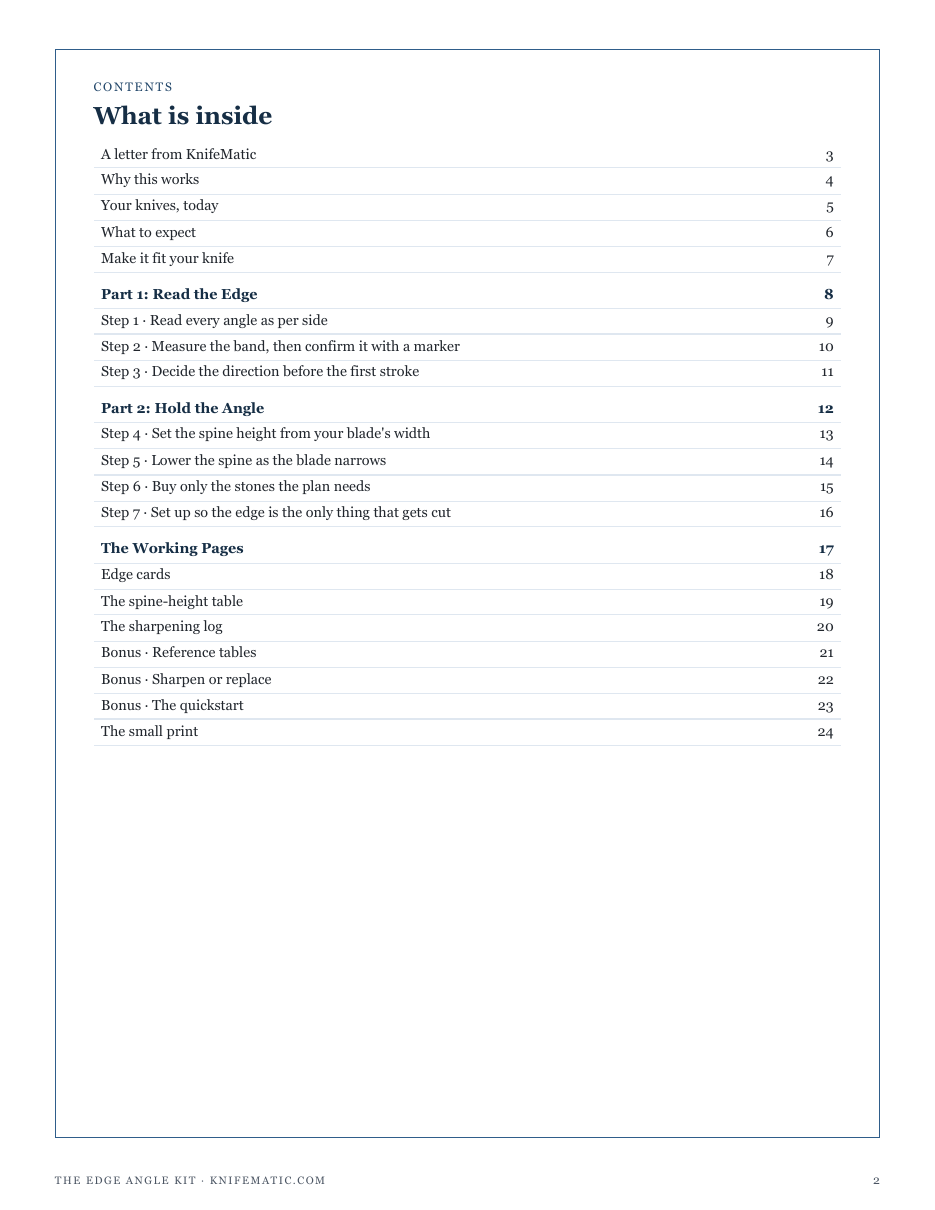
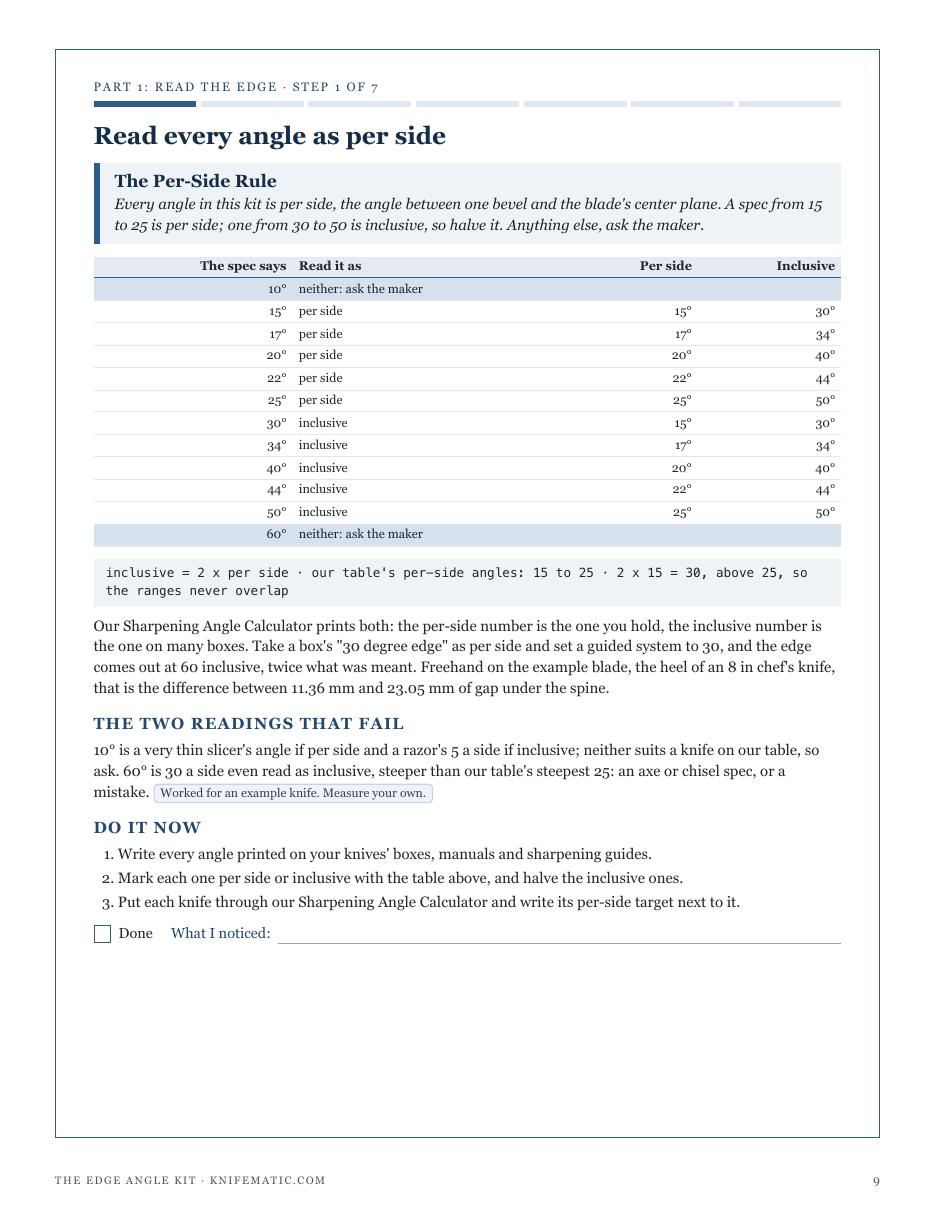
What is in it
- The Per-Side Rule: reading any angle spec as per side or inclusive, from the site's own table
- The Band Rule: measuring the edge you have, what a 0.05 mm misread does, and the marker test
- The Direction Rule: match, raise or lower, and what a lower angle costs in steel
- The Midline Rule: the gap under the spine from your blade's width and spine thickness, and a coin-stack gauge
- The Tip Rule: lowering the spine as the blade narrows, station by station
- The Short Route Rule: only the stones the job needs, when to move on, and keeping the stone flat
- The Setup Rule: a stone that cannot slide, a cut-resistant glove, fingers behind the edge, and grinder safety
- Working pages: edge cards, a spine-height table and a sharpening log
- Reference tables and a sharpen-or-replace check worked with our Price-Per-Use Calculator
- A quickstart, and a personalised sheet worked from the numbers you entered
- ✓ 24 printable pages
- ✓ 10 sections, worksheets and templates
- ✓ A second PDF worked out from the numbers you enter
- ✓ No account needed, just an email address
- ✓ Instant download; link valid 7 days
Price includes any taxes. Sold by GrabURL, who handle checkout and support. The charge appears on your statement as GrabURL.
The kit picks up where the free Bevel Angle Calculator and Sharpening Angle Calculatorleave off. One reads the angle your knife has, the other recommends the angle for its type; neither says what to do when they disagree or how to hold either number on a stone. The kit reads every angle per side, confirms the measured edge with a marker test, decides whether to match, raise or lower (and prices a lower angle in steel), sets the spine height from your blade's own width and spine, lowers it toward the tip, and routes you through only the whetstone grits the job needs. It carries the sharpening safety facts: a stone that cannot slide, fingers behind the edge, a cut-resistant glove, strokes away from the body, and eye protection and a cool edge on a grinder or belt sander. The worked figures are examples; your own knife replaces them.